
by Aisha Cruse
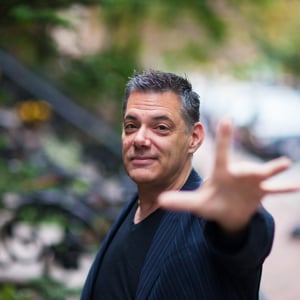
A quick bit of background; a few weeks before the festival, the Dance Complex invited the ChoreoFest participants to take part in a Choreographer's Workshop lead by Peter, which was part of a longer event called Summer Sizzle. I eagerly accepted, and spent an amazing three hours building and deconstructing movement.
Given the Dance Complex's continued support of ChoreoFest, and knowing that Peter would be attending the performances, it made perfect sense to ask him some follow-up questions on the workshop and on ChoreoFest. Peter graciously and eloquently accepted.
Aisha Cruse: What made you invite the ChoreoFest participants to the Choreographer's Workshop?
Peter DiMuro: I often feel, that as young dance-makers, we're thrown into the world post-college or post-training with very little preparation as to what it means to "make dances". We're taught to make phrases, make-up movement. In technique class, there are combinations- often in straight lines across the floor. Even if we get to take a composition or choreography class, there is so little time to "undo" the majority of the time we spend in our training- isolating the technique from the "communication through movement".
I had seen the Choreofest through video and live snippets over the past few years, and felt that we might be able to help frame the intense 24 hour period with a mind set (and body-set!) that could de-rail the trained impetus to "gotta make up movement.." vs. "what are we communicating".
Aisha: The workshop we attended was part of a larger week-long event, which included an opportunity for choreographers to make and show work. Can you tell us a little about what
your goals were during the event and if it will be happening again?
Peter: Each year we do two seasonal festivals- Winter Wonder and Summer Sizzle. This year, Summer Sizzle seemed to take on a new thread of creation- there was a choreographer's track as a through line, as well as some body/mind/moving somatics classes with Pam Pietro. I think with the choreo track and Pam's classes, the parallel in "how" we think about dance is the key ingredient: if we don't question the way we move, think, bundle and unbundle bodies and ultimately change (the hard part!!!), then we don't really have a chance to change the way we move, the way we create/craft dances.
As The Dance Complex continues, we will also keep reinforcing sustainable ways of thinking/doing- in our own Festivals like Winter Wonder and Summer Sizzle, but in on-going workshops we produce throughout the year- the CATALYST Classes, for instance.
Aisha: ChoreoFest is incredibly happy to have the continued support of the Dance Complex. What kind of involvement does the Dance Complex (or do you) want to have with ChoreoFest in the future?
Peter: Since arriving here 2 summers ago, I feel like I am just understanding what the community holds as gifts to us- us at The Dance Complex but also for the whole community. It would be great to be involved with a workshop prior to the ChoreoFest as we did this year; I think it would/could get more means of interrupting patterns, ways of thinking.
I could see some of the works continuing on- and being presented in workshop or performance here say a few months later- what seed ideas are worth keeping or evolving into more?
Aisha: Were there any moments while watching the performances that you saw or felt a connection to the skills we covered or discussions we had in the choreographer's workshop?
Peter: Of course the egotist in my wants to say, Sure! Everything connected! I'd love to ask the choreographer's the same question : how did they - or now, with reflection a few days later- interrupt the creative process patterns, movement patterns, spatial patterns, when under the gun like that.
I do think in watching that I saw the overall form of the dances- from each individual choreographer- be less connected to a known form (first a duet, now a solo, now a trio...now group unison- the kind of choreography that speaks to fulfilling some list of known ingredients). The dances felt more organically formed. And I sensed ownership by the dancers dancing- my own methods include a lot of work to get those performing to "own" movement right from the get-go, and not as a layer on top of "adding the performance", so this always is something that pops out.
It might be the nature of the 24 hour finite-ness that choreographers sense that they share creation/ownership in the process of making...or maybe partly the workshop that un-did some unspoken rule of the choreographer creating top down.
And I saw less unison! (That tool of the devil!) and when unison occurred, it felt less out of nowhere.
I'd encourage an examination of what, objectively with a few days passing, worked- even the unintentional aspects in performance, form, movement generation- and see if there is some way to set the likelihood that these can occur again..and that requires reflection and changing pattern....(It's always back to that! Dang!)
For more on Peter's work, please visit his website, PDM:Public Displays of Motion.
You can also find him on Facebook.
Peter DiMuro: I often feel, that as young dance-makers, we're thrown into the world post-college or post-training with very little preparation as to what it means to "make dances". We're taught to make phrases, make-up movement. In technique class, there are combinations- often in straight lines across the floor. Even if we get to take a composition or choreography class, there is so little time to "undo" the majority of the time we spend in our training- isolating the technique from the "communication through movement".
I had seen the Choreofest through video and live snippets over the past few years, and felt that we might be able to help frame the intense 24 hour period with a mind set (and body-set!) that could de-rail the trained impetus to "gotta make up movement.." vs. "what are we communicating".
Aisha: The workshop we attended was part of a larger week-long event, which included an opportunity for choreographers to make and show work. Can you tell us a little about what
your goals were during the event and if it will be happening again?
Peter: Each year we do two seasonal festivals- Winter Wonder and Summer Sizzle. This year, Summer Sizzle seemed to take on a new thread of creation- there was a choreographer's track as a through line, as well as some body/mind/moving somatics classes with Pam Pietro. I think with the choreo track and Pam's classes, the parallel in "how" we think about dance is the key ingredient: if we don't question the way we move, think, bundle and unbundle bodies and ultimately change (the hard part!!!), then we don't really have a chance to change the way we move, the way we create/craft dances.
As The Dance Complex continues, we will also keep reinforcing sustainable ways of thinking/doing- in our own Festivals like Winter Wonder and Summer Sizzle, but in on-going workshops we produce throughout the year- the CATALYST Classes, for instance.
Aisha: ChoreoFest is incredibly happy to have the continued support of the Dance Complex. What kind of involvement does the Dance Complex (or do you) want to have with ChoreoFest in the future?
Peter: Since arriving here 2 summers ago, I feel like I am just understanding what the community holds as gifts to us- us at The Dance Complex but also for the whole community. It would be great to be involved with a workshop prior to the ChoreoFest as we did this year; I think it would/could get more means of interrupting patterns, ways of thinking.
I could see some of the works continuing on- and being presented in workshop or performance here say a few months later- what seed ideas are worth keeping or evolving into more?
Aisha: Were there any moments while watching the performances that you saw or felt a connection to the skills we covered or discussions we had in the choreographer's workshop?
Peter: Of course the egotist in my wants to say, Sure! Everything connected! I'd love to ask the choreographer's the same question : how did they - or now, with reflection a few days later- interrupt the creative process patterns, movement patterns, spatial patterns, when under the gun like that.
I do think in watching that I saw the overall form of the dances- from each individual choreographer- be less connected to a known form (first a duet, now a solo, now a trio...now group unison- the kind of choreography that speaks to fulfilling some list of known ingredients). The dances felt more organically formed. And I sensed ownership by the dancers dancing- my own methods include a lot of work to get those performing to "own" movement right from the get-go, and not as a layer on top of "adding the performance", so this always is something that pops out.
It might be the nature of the 24 hour finite-ness that choreographers sense that they share creation/ownership in the process of making...or maybe partly the workshop that un-did some unspoken rule of the choreographer creating top down.
And I saw less unison! (That tool of the devil!) and when unison occurred, it felt less out of nowhere.
I'd encourage an examination of what, objectively with a few days passing, worked- even the unintentional aspects in performance, form, movement generation- and see if there is some way to set the likelihood that these can occur again..and that requires reflection and changing pattern....(It's always back to that! Dang!)
For more on Peter's work, please visit his website, PDM:Public Displays of Motion.
You can also find him on Facebook.


